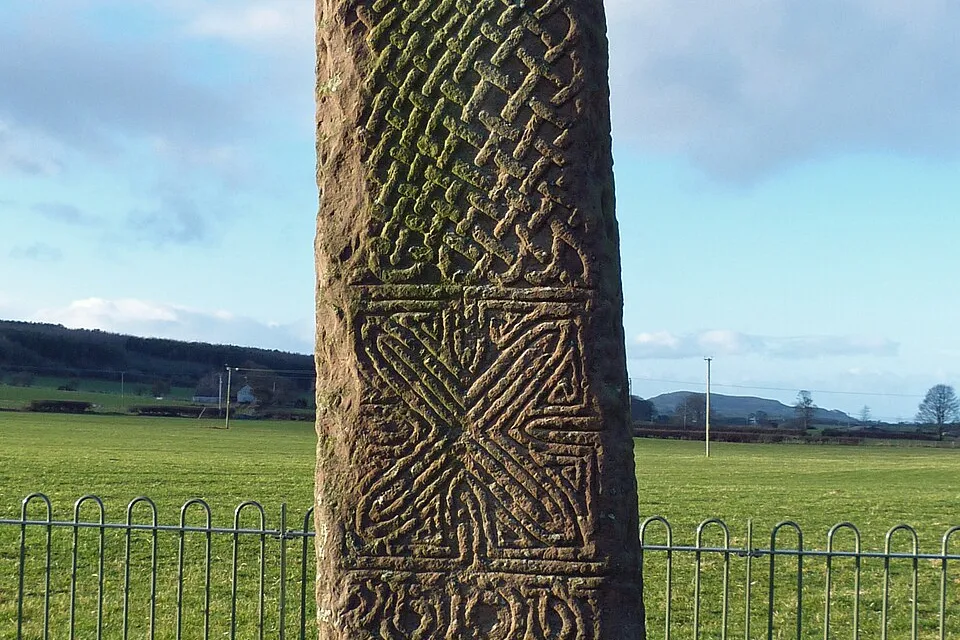
Photo via Wikimedia Commons — licence & author.
Maen Achwyfan Cross, Whitford
The tallest wheel cross in Britain has stood in the same Flintshire field corner for a thousand years, carved with Viking-age knots and beasts, visited by almost no one.
- Two-minute wonder stops
- Early medieval art
- Quiet contemplation
- Photographers in low light
✅ Walked & checked: July 2026 · themes: Ancient sites
There is no car park, no sign from the main road, no interpretation centre, and no gift shop. There is a field corner where two quiet lanes meet, and in it, rising four metres against the Flintshire sky, the tallest wheel cross in Britain — carved when Cnut was learning English, and never moved since.
What it’s actually like
The wonder of Maen Achwyfan is the intact-ness of the encounter. You step off the lane, cross ten metres of grass, and stand alone with an object a millennium old: a disc-headed cross of local sandstone, every face worked with plaited knotwork, ring-chains and — look low on the west side — a small worn human figure among beasts, generally read as a Norse-influenced hero scene. The style is the Irish Sea’s Viking-age lingua franca; cousins stand on the Isle of Man and in Cumbria, but none taller.
What was it for? A preaching cross, a boundary of sanctuary land belonging to nearby Holywell, a penitential monument by a repentant magnate — scholarship shrugs. Its name, “stone of lamentations”, only deepens the pool. What’s certain is a thousand years of continuity: ploughs, Reformation, wars and A-roads have all flowed around this field corner and left it be.
Getting there and parking
It stands where the lanes meet at Whitford, two minutes from the A5151 (grid reference in the facts panel — trust it over your satnav’s opinions). There’s verge space for a couple of considerate cars by the field gate. Access is open, free and permanent; low morning or evening sun brings the carving up best, and a dusting of frost is even better.
Make a day of it
Maen Achwyfan is the middle move of our favourite local history evening: start on the Gop for prehistory and views, stop here for the Viking age, and finish at St Winefride’s Well in Holywell — three miles and four thousand years apart. Downhill from the well, Basingwerk Abbey’s ruins and the Greenfield Valley’s mill ponds finish the timeline at the Industrial Revolution.
Common questions
How old is Maen Achwyfan?
Around the year 1000 — the end of the Viking age in the Irish Sea world. The carving mixes Celtic interlace with Scandinavian-style ring-chain patterns, which tells you exactly what a cultural crossroads this coast was.
What does the name mean?
'The stone of lamentations' — possibly linked to St Cwyfan. Nobody is certain whether it marked a preaching station, a boundary, a grave, or an act of penance. Like all the best monuments, it keeps its counsel.
Can you walk right up to it?
Yes — it stands behind a low rail in the corner of a field where two lanes meet, with open access at all times and no fee. Look for the faint carved figure on the lower west face, and run your eye up four metres of thousand-year-old knotwork.
Is it worth a special trip?
As a destination alone, it's a 20-minute stop. As the anchor of a local ancient-places loop with the Gop and St Winefride's Well — absolutely. It's also thirty seconds off the route between them.
Staying over?
Holywell makes a relaxed base for exploring the area — worth staying over to catch an early start or a golden-hour finish.
Browse places to stay near Holywell ↗ opens Booking.com — needs signalNearby, also worth your time
Planning a proper day of it?
The free Explore Wales trip planner chains stops with drive times, checks the weather, suggests campsites, and syncs the plan with your friends — and it all works offline once installed.